
Three days cover the lake, the gardens and the old city; with five or six you can add Gulmarg, Pahalgam or Sonamarg. Each season changes the landscape: tulips in spring, green meadows in summer, red chinar trees in autumn and snow in winter.
What to see in Srinagar: top sights
Dal Lake and a shikara ride

The soul of Srinagar: a vast lake dotted with carved wooden houseboats, floating gardens and islets such as Char Chinar, with its four chinar trees. Exploring it by shikara, the traditional canopied boat, is the city’s essential experience. At dawn, vegetable sellers gather by boat for the floating market.
Recommended time: 2–3 h
Tip: Shikaras leave from the ghats along the Boulevard. Agree on the route and duration before you get in, and get up early if you want to see the floating market.
Hotels near Dal Lake and a shikara ride · 220 propertiesNishat Bagh
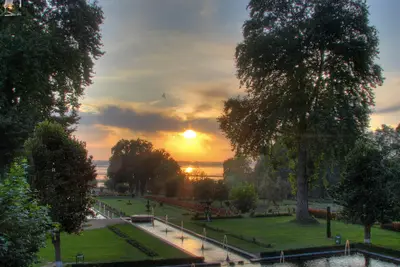
The largest of Kashmir’s Mughal gardens, built in the 17th century by Asif Khan, brother of Empress Nur Jahan. Twelve terraces step down from the mountain to the lake between channels, fountains and centuries-old chinar trees, with the whole of Dal Lake at your feet.
Recommended time: 1–1.5 h
Tip: Sunset light over the lake from the top terrace is the best of the day.
Shalimar Bagh
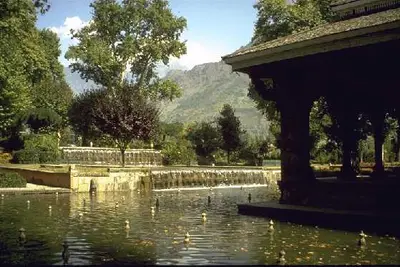
The garden Emperor Jahangir built for Nur Jahan in 1619: terraces, cascades and a black marble pavilion surrounded by fountains. More intimate and elegant than Nishat Bagh, with the same giant chinar trees.
Recommended time: 1 h
Pari Mahal and Chashme Shahi

Pari Mahal, the “fairies’ palace”, is a terraced garden with stone arcades that Prince Dara Shikoh turned into a school of astrology in the 17th century. It sits high on the hillside and has the best view of the lake. Just below, the small Chashme Shahi garden was built around a spring famous for its pure water.
Recommended time: 1–1.5 h
Tip: Go late in the afternoon: sunset over Dal Lake from Pari Mahal is unforgettable.
Hazratbal Shrine

The great white marble mosque on the lakeshore, Kashmir’s most revered shrine: it holds a relic the faithful believe to be a hair of the Prophet Muhammad. Its dome and minaret reflected in the water are one of Srinagar’s defining images.
Recommended time: 45 min
Tip: Wear clothes that cover arms and legs, take your shoes off to go in and, for women, bring a headscarf. Avoid prayer times, especially Friday midday.
Shankaracharya Temple

A small stone temple to Shiva on a hilltop above the city, one of the oldest in Kashmir. You go up by road and then about 240 steps, and from the top all of Srinagar, the lake and the valley are laid out below.
Recommended time: 1.5 h
Tip: There are usually security checks on the way up: travel light and ask at the bottom what you can take.
Jama Masjid and the old city

The great Friday mosque, medieval in origin, with a courtyard surrounded by hundreds of deodar-wood pillars. It is the gateway to the old city (Downtown): lanes, wooden houses, bridges over the Jhelum and shrines such as Khanqah-e-Moula, with its painted wooden interior.
Recommended time: 2–3 h
Tip: Explore the old city on foot and by day, ideally with a local guide who can open the doors of papier-mâché and carpet workshops.
Tulip Garden

Asia’s largest tulip garden, terraced in front of the lake at the foot of the mountains. It opens for only a few weeks in spring, when more than a million and a half tulips of dozens of varieties bloom: Srinagar’s busiest time of year.
Recommended time: 1–2 h
Tip: Dates depend on the weather: usually from late March to late April. Go first thing to avoid the crowds.
Hari Parbat Fort

The 18th-century fortress crowning Koh-i-Maran hill. On its slopes the Muslim shrine of Makhdoom Sahib, the Hindu temple of Sharika Devi and a Sikh gurdwara stand side by side, a good summary of the city’s history.
Recommended time: 1.5 h


Day trips from Srinagar
Gulmarg
1.5–2 h by car
A high mountain meadow ringed by conifer forests. Its gondola, one of the highest cable cars in the world, climbs towards Mount Apharwat: in winter it is India’s best ski resort, and in summer, flower meadows and pony rides.
Pahalgam
2.5–3 h by car
The Lidder river valley, with meadows, pine forests and turquoise water. From here you can visit Betaab Valley and Aru village, and it is the starting point for Himalayan treks.
Sonamarg
2–2.5 h by car
The “meadow of gold”, on the Sindh river at the foot of glaciers such as Thajiwas, reached on foot or on horseback. It is also the gateway to the road to Ladakh.
Srinagar in 3 days
Day 1
Day 1: a shikara ride on Dal Lake in the morning, then Hazratbal and the Nishat Bagh and Shalimar Bagh gardens in the afternoon. Sunset on the Boulevard.
Day 2
Day 2: the old city on foot, with the Jama Masjid, Khanqah-e-Moula and the Jhelum; in the afternoon, Hari Parbat and the climb to the Shankaracharya Temple.
Day 3
Day 3: a day trip to Gulmarg and its gondola, or to Pahalgam or Sonamarg. In spring, keep a morning for the Tulip Garden and Pari Mahal.
Srinagar with kids
- The shikara ride and, if you can, a night on a houseboat.
- The Gulmarg gondola and playing in the snow, even in spring higher up.
- Pony rides across the meadows of Pahalgam and Sonamarg.
- Running along the terraces and fountains of the Mughal gardens.
Free things to do in Srinagar
- Strolling the Boulevard along the lake at sunset.
- The floating vegetable market at dawn, seen from the shore.
- Wandering the old city and the bridges over the Jhelum.
- The view of the lake from around Hazratbal.
Where to stay in Srinagar
Sleeping on a houseboat on Dal or Nigeen Lake is part of the trip, at least for one night. To get around the city, the hotels on the Boulevard and in Rajbagh are the most practical.
Dal Lake and the Boulevard
Houseboats at every level and hotels along the lakeside promenade, with the shikara ghats on the doorstep. The busiest and liveliest area.
Places to stay in Dal Lake and the Boulevard · 220 propertiesNigeen Lake
North of Dal Lake, calmer and less crowded, with upscale houseboats and open views. For a few peaceful days.
Rajbagh
A residential district on the Jhelum, central and quiet, with good hotels and restaurants. Well placed for both the lake and the centre.
Places to stay in Rajbagh · 842 propertiesLal Chowk
The city’s commercial centre: simple hotels, shops and transport. Practical and busy.
Places to stay in Lal Chowk · 237 propertiesGulmarg
For skiing in winter or waking up in the mountains in summer, with the gondola a short walk away.
Places to stay in Gulmarg · 111 propertiesPahalgam
Hotels by the Lidder river, surrounded by forest, as a base for trekking and the nearby valleys.
Places to stay in Pahalgam · 392 properties
When to go to Srinagar
Spring (March–May) brings the tulips and almond blossom; summer (June–August) is mild and the peak season; autumn (September–November), with the chinar trees turning red and clear skies, is for many the best time of all.
Winter (December–February) is very cold and snowy: it is ski season in Gulmarg, but some mountain roads close. Houseboats and hotels have heating, but it is worth checking when you book.
Book activities in Srinagar
Tours, tickets and day trips with live availability and prices.
Activities from an external partner, which may use its own cookies. These are affiliate links: if you book, we may earn a commission at no cost to you. Cookie policy
Frequently asked questions about Srinagar
Is it safe to travel to Srinagar?
Srinagar welcomes a great many travellers every year, but the situation in Kashmir can change. Before booking and during your trip, check your government’s official travel advice and follow the instructions of local authorities.
Is it worth staying on a houseboat?
Yes, for at least one night: the carved wooden houseboats are unique to Srinagar. Read the reviews carefully, as quality varies a lot, and check whether the shikara transfer from the shore is included.
When do the tulips bloom in Srinagar?
Usually between late March and late April, for a few weeks. The exact dates depend on each year’s weather.
How do you get to Srinagar?
By air: Srinagar airport has direct flights from Delhi, Mumbai and other cities, about 12 km from the centre. Overland, from Jammu by road or by train on the Kashmir valley line.
How many days do you need in Srinagar?
Three days for the lake, the gardens and the old city; five or six to add Gulmarg, Pahalgam and Sonamarg.
Guide written by the buiigo team · Updated October 29, 2026
Photo credits
Srinagar: Basharat Shah, CC BY 2.0 · Dal Lake and a shikara ride: Fulvio Spada from Torino, Italy, CC BY-SA 2.0 · Nishat Bagh: McKay Savage, CC BY 2.0 · Shalimar Bagh: Hans Nelisse, Public domain · Pari Mahal and Chashme Shahi: Vinay Parepalli, CC BY-SA 4.0 · Hazratbal Shrine: Zuck28, CC BY 4.0 · Shankaracharya Temple: Divya Gupta, CC BY-SA 3.0 · Jama Masjid and the old city: Mike Prince from Bangalore, India, CC BY 2.0 · Tulip Garden: Kevin.abraham335, CC BY-SA 4.0 · Hari Parbat Fort: Mohamad Talib Bhat, CC BY-SA 3.0


